

Indonesia Faces Backlash After Joining Trump’s ‘Board of Peace’, Amnesty Says
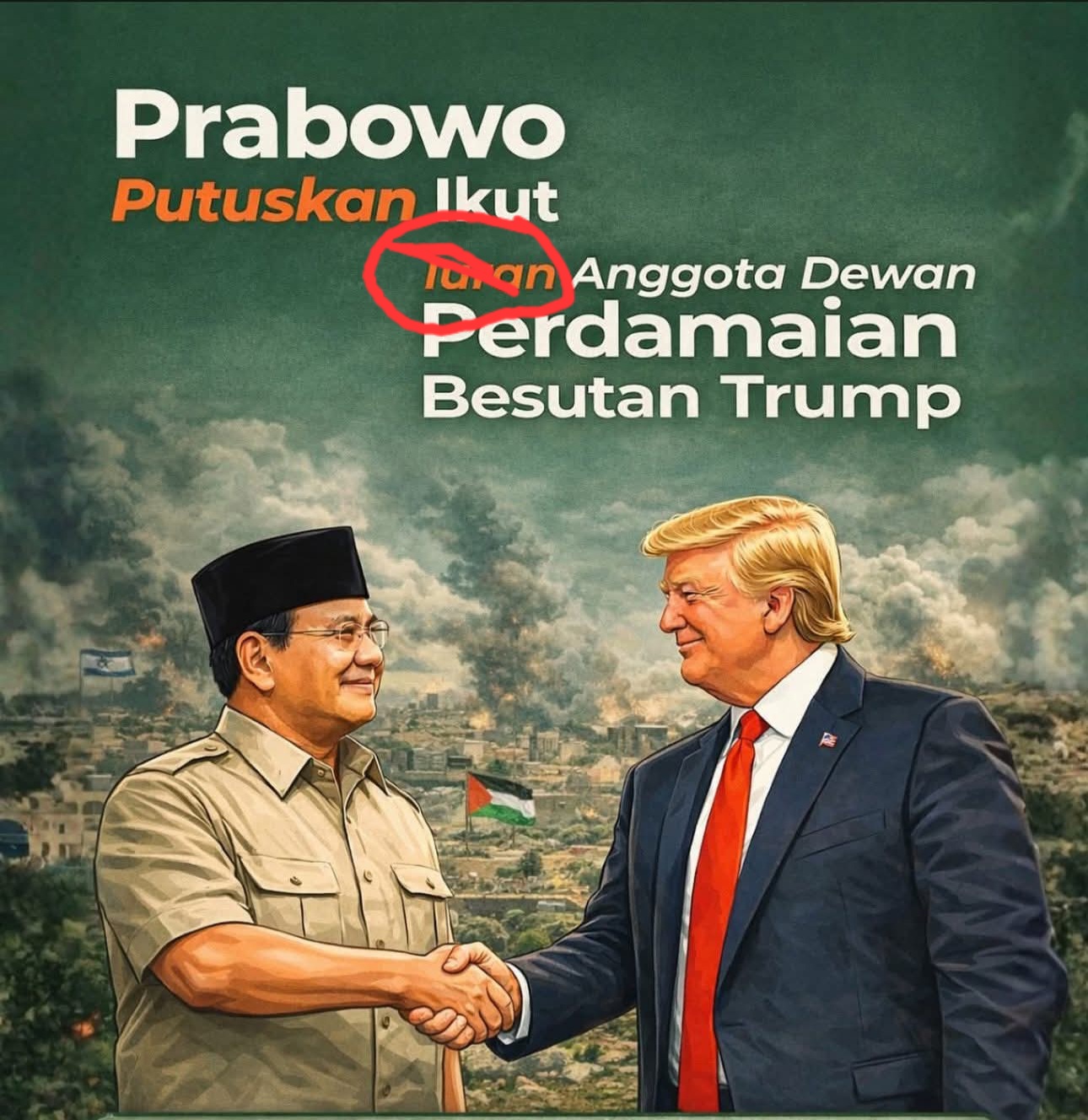
JAKARTA, RAKYAT NEWS — Amnesty International Indonesia has strongly criticized the Indonesian government’s decision to join the “Board of Peace,” an initiative spearheaded by former United States President Donald Trump, calling the move a troubling display of double standards and a blow to international law and universal human rights norms.
Usman Hamid, Executive Director of Amnesty International Indonesia, questioned Indonesia’s credibility on the global stage, particularly as the country currently holds a leadership role within the UN Human Rights Council.
“How can Indonesia effectively lead the Human Rights Council while blindly following Trump, who is actively undermining the United Nations system?” Hamid said. “This is deeply concerning. The so-called Board of Peace is part of Trump’s broader assault on the UN, international justice institutions, and universal norms.”
According to Amnesty, the initiative—despite its stated aim of promoting peace—undermines international law and weakens global guarantees of universal human rights, including those upheld through the UN Human Rights Council itself.
“Under the guise of peace, Trump is attacking international law and eroding universal human rights protections,” Hamid said. “Indonesia’s participation only reinforces the perception of double standards.”
Amnesty further described Indonesia’s decision as a setback to decades-long efforts to strengthen the global order through adherence to universal values and equality among UN member states.
“Rather than helping to reform and strengthen the system, Indonesia is now complicit in dismantling the very principles of universality and equality painstakingly built since World War II,” Hamid added.
“This is precisely the moment when international law must be upheld—not abandoned in favor of ad hoc arrangements distorted by unilateral political and economic interests, personal ambition, and Trump’s arrogance.”
Amnesty International Indonesia urged the government to publicly explain its rationale for joining the Board of Peace and called on Indonesia’s House of Representatives (DPR), particularly Commission I, to immediately summon the Minister of Foreign Affairs for clarification.
“Commission I has a constitutional duty to ensure that Indonesia’s foreign policy aligns with the Constitution, which upholds world peace through international law and universal human rights principles,” Hamid said.
The organization also stressed that any peace initiative concerning Palestine must meaningfully involve the Palestinian people themselves, as their future is directly at stake.
“Amid ongoing, systematic restrictions on humanitarian aid to Gaza—conditions that increasingly point toward genocide—Indonesia’s decision to align with the United States without involving the Palestinian people reflects a disturbing double standard,” Hamid stated. “Peace built by excluding victims is not genuine peace.”
He warned that such a stance not only weakens Indonesia’s constitutional commitment to humanity and justice but also risks legitimizing and perpetuating the gravest crimes against humanity.
Indonesia officially joined the Trump-initiated Board of Peace following a meeting on the sidelines of the World Economic Forum in Davos on Thursday, 22 January 2026. President Prabowo Subianto stated that the decision reflected Indonesia’s active role in pursuing peace in Gaza, framing it as part of the country’s humanitarian and peace commitments.
However, more than two months after the ceasefire, and despite legally binding orders from the International Court of Justice (ICJ)—including an advisory opinion issued in October 2025 affirming Israel’s obligations as an occupying power—conditions in Gaza remain dire.
The ICJ ruling emphasized Israel’s duty to ensure access to essential supplies and facilitate the work of UNRWA and other UN agencies. This position was reaffirmed by a recent UN General Assembly resolution urging Israel to comply with its legal obligations regarding humanitarian assistance in Gaza.
Despite these developments, Israel has continued to allow only minimal aid into Gaza, leaving a population with virtually nothing, living in extreme deprivation amid widespread destruction.
According to Amnesty International, these conditions demonstrate the continued, deliberate imposition of living conditions on Palestinians in Gaza designed to bring about their physical destruction—acts prohibited under the Genocide Convention.(Uki)




















Tinggalkan Balasan